Affordable robots for everyday work.
An ecosystem of affordable multipurpose robots, made in America. Our first robot, QV1, clears tables and handles trash in restaurants, so staff can focus on guests.
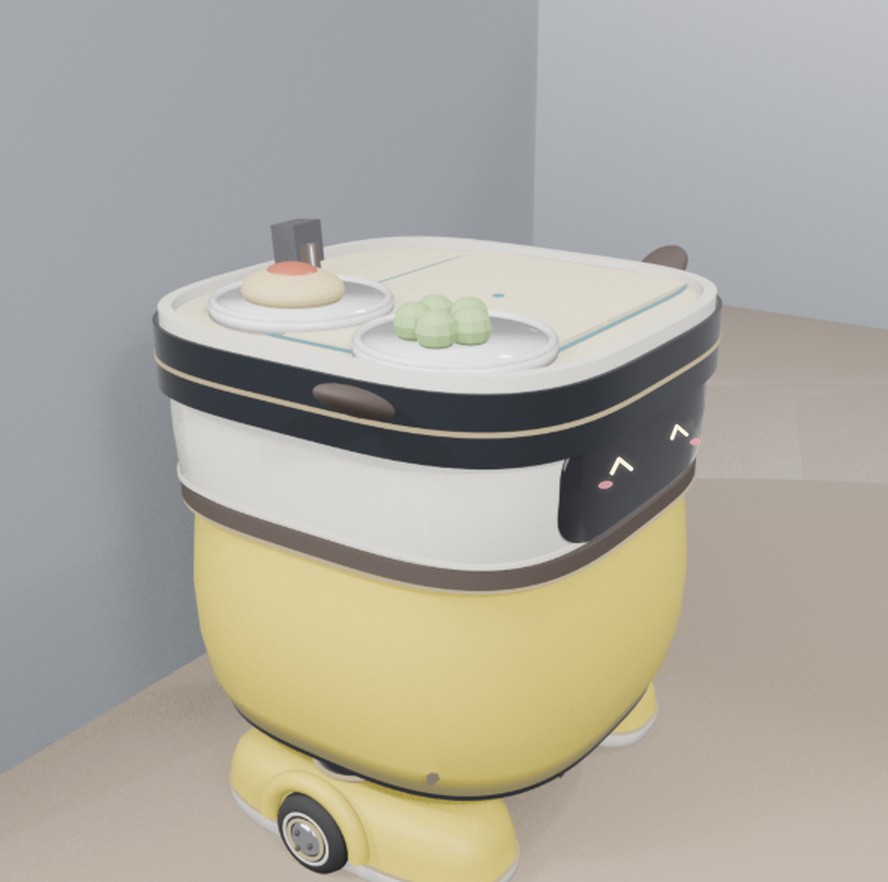
// rendered concept of QV1
The problem
Restaurants can’t keep staff.
Clearing tables and taking out trash keeps staff away from guests, and it’s the work nobody stays for.
restaurant staff turnover in 2025: more than the whole team, every year
of operators say hiring and keeping staff is a significant challenge
restaurants we interviewed told us the same story
Source: National Restaurant Association, 2026 Hiring and Staffing report.
Our first robot
QV1 finishes the whole job.
Today’s restaurant robots only carry trays: staff still load them, clear the table and take out the trash. QV1 is a mobile robot with a lift, an arm, onboard storage and its own trash compartment.
Pick up
Lifts to table height and picks up cups, plates and litter with its arm.
Serve or store
Places items on its tray or into washable storage bins.
Collect waste
Drops litter into its own onboard trash compartment.
Close the bag
Closes and releases its trash bag into a collection bin.
And it’s lovable: an expressive face and personality that guests enjoy having around. Restaurants can rent it monthly or buy it outright, with maintenance included.
Demo
One core. Four places to work.
QV1 in a restaurant, then the same core in a supermarket, an office and a home.
Engineering
Simulated in physics before we build.
Every QV1 part is checked in CAD and run through the full restaurant routine in MuJoCo, a physics simulator, with real motor limits, plate weights and friction.
// MuJoCo physics simulation · 2x speed · serving, storage and driving between tables
Why it’s different
Today’s robots work in 2D. Real work happens in 3D.
A restaurant doesn’t want five robots. It wants the table turned and the trash handled, and that needs an arm at an affordable price.
Business model
Rent it or buy it. It pays for itself.
High-end · restaurants, supermarkets, offices
QV1 full-service
Does the full job for all-day use: lifts to table height, picks up plates, cups and litter, stores them, and handles its own trash.
Standard · homes, cafés, small shops
Lighter model
Simpler and lighter, for smaller spaces and lighter workloads. Also available to rent at a lower monthly price.
// Early estimates, to be refined with pilot customers. Busser wage: BLS median ~$15/h (~$17/h with payroll costs). Restaurant count: IBISWorld via Toast. Target build cost $5,000–9,000 per high-end robot, 40–50% gross margin.
The vision
One ecosystem. Each new robot makes the others more useful.
Restaurants
QV1 clears tables and handles trash.
Supermarkets and offices
Restocking, tidying, trash and deliveries.
Homes
Tidying and everyday chores for families.
Every Eqavio robot shares one core, one app and one personality: the same brain, arm, base, battery and software. Each knows your space and works with the others, and new skills reach every robot through software.
Made in America
Designed and built in Arizona.
Why it matters
In July 2026, the FCC added foreign-produced advanced robotic devices to its Covered List. Most service robots today are imported, which makes domestic manufacturing and sourcing strategically important for connected robots.
Our plan
- Assemble in Arizona from purchased parts.
- Make our own motors and joints to cut cost.
- Raise domestic content as we grow.
Our first prototype costs about $5,000 in parts, all bought from US sellers. Making our own materials, motors and joints will bring that down. Our rule: make it work first, then make it cheaper.
Progress
Designed, simulated, now building.
- Interviewed 30 restaurants plus supermarket staff about their staffing problems
- Full CAD design of QV1, with 0 part clashes through the arm’s fold
- Physics simulation: 16/16 restaurant tasks, 100/100 randomized trials
- Arm designed and load-checked to carry a 0.8 kg plate at table height
- Staged, test-gated build: each wave of parts is bought only after the last passes its tests
- Stage 1 hardware being ordered: gripper and shoulder bench tests, prototype parts funded through Professor Wanxin Jin’s IRIS Lab at ASU
Nov–Dec 2026
Bench tests
Gripper and shoulder on the bench
Jan–Feb 2027
Full robot
Driven by remote control
Mar–May 2027
Autonomy
Tasks run on their own
Summer–Fall 2027
First pilot
In a real restaurant
Team
Two engineers who can build the whole robot.
We met in a circuits class sophomore year at Arizona State University and have been building things together ever since.
Ji Yang Lim
Co-founder · Electrical Engineering, ASU
Builds robots end to end, from power electronics and firmware to mechanical design. Leads QV1’s hardware layout, power and mechanics.
- Precision robotic arm in C++
- Real-time ESP32 firmware
- Electromechanical lift design
- EV fast-charging hardware, WattEV
- Materials research, ASU
Kevin Cyril
Co-founder · Computer Systems Engineering, ASU
Robot firmware, hardware integration and full-stack software. Leads QV1’s control, navigation and software.
- Mobile-robot firmware in C
- PID motor control and navigation
- FPGA processor design (Verilog)
- Full-stack software
Advisor: Professor Wanxin Jin, IRIS Lab, Arizona State University, whose lab funds the prototype parts.
Get in touch
Run a restaurant? Want to invest or build with us?
We’re looking for pilot restaurants, partners and investors. We’d love to hear from you.